Primitive 01Model-controlled
{ }
Tools
Executable operations such as creating a ticket, running a query, or posting a message. Inputs and outputs are described with schemas.
Guard with permissions + approval
A living MCP blueprint / Updated Sep 25, 2026 / 11 min read
The protocol can connect an agent to tools, context, and reusable workflows. It does not decide who may act, what should be approved, or how failure is contained.
That operational layer is the Agentic Harness.
This visual guide responds to Daniel Jeong and ManoIT's April 2026 MCP guide on DEV, then reconciles its model with the final 2026-07-28 specification.
Read the source article ↗01 / The durable model
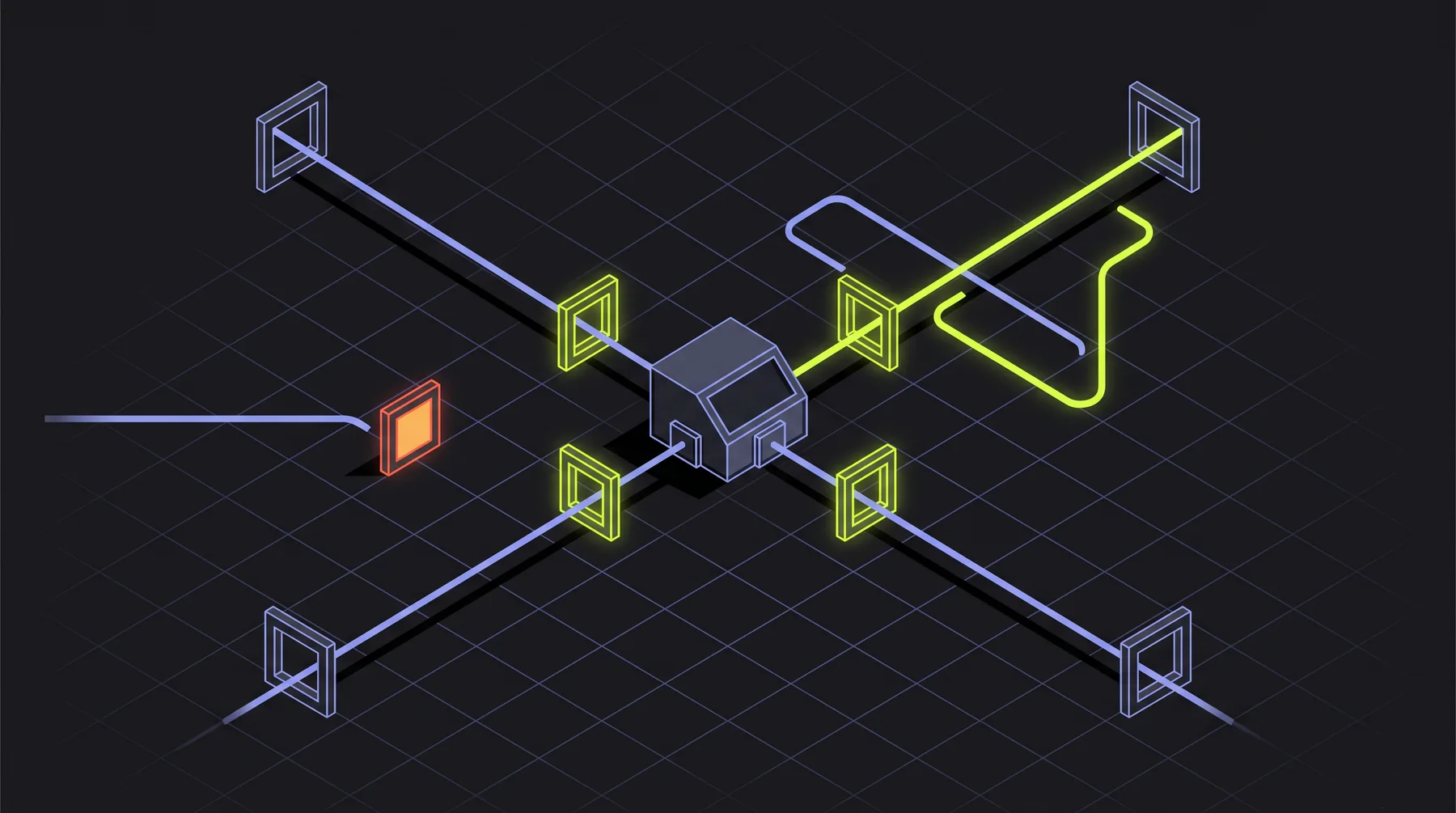
MCP separates the application that owns the experience from the component that maintains a server connection, and from the service that exposes capabilities. Follow a request through that topology, and back again.
The AI application owns the user experience, policy, and orchestration.
A protocol component maintains the connection to one server.
A local or remote service exposes narrowly described capabilities.
host: decides the task and selects an eligible MCP connection
host: decides the task and selects an eligible MCP connectionclient: packages the request and routes it across the negotiated transportserver: validates the call, executes a capability, and returns structured outputhost: returns the reply only to the sender or thread that asked, never a destination the model picked, and reports what happened: saved, drafted, or sentThe host is the control plane. It can create multiple clients, and each client speaks to one server. The server publishes what it can do; the client negotiates capabilities; the host decides how those capabilities enter a larger workflow.
That boundary is the important idea: MCP standardizes the exchange, while the surrounding product still owns consent, identity, model behavior, observability, and recovery. The official architecture overview is the reference point for this model.
The fourth step is the one demos skip. A result has to go back to whoever asked, and the product has to say what actually happened. Deyaf puts the same boundary in plain words: the model is one step of four (listen, look it up, check the rules, reply), and everything around that step is the harness's job.
02 / The capability surface
The three server primitives look similar in a menu, but they carry different intent and control. That difference should shape both interface and policy.
Executable operations such as creating a ticket, running a query, or posting a message. Inputs and outputs are described with schemas.
Guard with permissions + approval
Context that an application can retrieve—documents, records, configuration, or other data addressable by URI.
Guard with scope + provenance
Reusable interaction templates that package instructions and arguments for a specific, discoverable workflow.
Guard with clarity + review
The DEV guide correctly makes these primitives central. The production refinement is to treat every primitive as a policy object: attach ownership, sensitivity, allowed identities, audit expectations, and a failure mode before it reaches a model.
Anthropic's guidance on writing tools for agents reaches the same place from the model's side: fewer, clearly named tools with readable output behave like a contract. A short, deliberate tool list is also easier to govern than a long one.
03 / The July spec diff
The April article captured the 2025-11-25 protocol well. The 2026-07-28 specification, final since July 28, changed important parts of the operational picture.
A long-lived protocol session coordinates capability negotiation and request state.
The final specification removes the initialize handshake and the session ID from the core request model.
The source roadmap described the official registry as a later-2026 destination.
The official registry is still in preview (checked Sep 25, 2026), with namespaces, a REST API, and standardized installation metadata.
New functions would tend to accumulate inside a single specification lifecycle.
The extensions framework lets features move without destabilizing the core. In the final specification, Tasks ships as an extension.
Server-to-client requests leaned on a live, bidirectional connection, and infrastructure had to read the payload to route a call.
A server can ask the client for input without holding a stream open. Mcp-Method and Mcp-Name headers carry routing, and list results can be cached.
The official project published the 2026-07-28 release candidate on May 21 and shipped the final specification on July 28, 2026. The release also adds RFC 9207 issuer validation and a formal twelve-month deprecation window (see the changelog). The registry is still marked preview; check it again before you depend on it.
04 / The trust boundary
A production MCP deployment should make the protected resource explicit, request the narrowest useful scopes, and reject tokens that were issued for another audience.
User + host trust zone
Requests authorization for a specific protected resource and sends the resulting token only to its intended MCP server.
Protected resource zone
Validates issuer, audience, expiry, and scopes. It uses a separate credential when calling an upstream API.
Protocol compliance is a starting point. The official security best practices also cover confused-deputy risks, session hijacking, local-server compromise, and scope minimization.
A harness operationalizes those rules across many agents and servers. Deyaf's trust and control principles start from the same place: choosing a channel records intent and does not connect anything, and the starting plan requires human review before external messages, record changes, or commitments.
Simon Willison's lethal trifecta names the combination to avoid: private data, untrusted content, and a way to send data out, all reachable by one agent. Every MCP server you add can quietly complete that set.
05 / Above the protocol
MCP makes capabilities portable. An Agentic Harness coordinates the decisions that determine whether those capabilities should become real work. Deyaf's working definition is plainer: “An Agentic Harness is everything around the AI model: what the assistant knows, what it remembers, where it meets customers, what it may do, and how your team teaches it.”
It watches the full workflow, applies policy before side effects, routes exceptions to people, checks the result, and contains failure. The protocol carries messages through that loop; it does not replace the loop.
Deyaf is built from Eve, Feniex's assistant, who already answers customers at every door. Deyaf's early-access builder lets your business set up its own; live doors switch on one at a time. Section 06 maps Eve onto these five layers.
Answering is not acting ↗06 / In production
Everything above is architecture. Here is a harness doing the work. Eve is Feniex's assistant: a warm, composed desk that helps people choose equipment, make a buying decision, or get support for equipment they own. Eve runs on the Agentic Harness Deyaf packages: her knowledge, memory, doors, rules and learning loop.
Will the model I'm looking at fit my vehicle?
fitment record → no answer in timeI couldn't check that just now, so I won't guess. Can I take your name and number for the team?
message taken → unanswered item saved → ticket pendingprovider accepted the ticket → only now: “It's with the support team.”Read her against the five layers of section 05. Identity: her name and per-language voices are fixed, and approved Feniex operators manage her rules and knowledge. She recognizes a returning customer's account context, limited to that one account; when several accounts match, she asks the customer to clarify.
Policy: the tool list and server-side queries hold her to four public actions. She checks the applicable record before any exact product, compatibility, warranty, price or software claim, because a convincing product name is not evidence. Approval: the public ladder has three levels (answer only, prepare for approval, run an approved task), set per workflow and per channel, with no single switch that lets her do everything.
Evidence: she describes only what the result proves: saved, drafted, sent, uncertain, acknowledged or resolved. Saving is not delivery, and drafting is not sending; that is step four of the trace in section 01. Recovery: an unanswered question on the web, phone, text or email becomes a durable item, and a ticket is filed when contact details are available. On the phone there are no transfers, by design: she answers from her library or takes a name and number for the team. What happens when she doesn't know is worth studying first.
Memory is layered, not total: four kinds of memory, each with one job. Customer notes are short and historical, never current facts; orders, invoices, shipments and balances are looked up fresh. When a person answers an unknown once, it is checked, then taught, in a supervised loop that measures before it teaches. Meet Eve, Feniex's assistant, for more.
07 / The customer's side
Everything in sections 01 to 04 happens out of sight. A customer meets a harness in two places first: a chat box in the corner of a page, and a phone that gets answered. At Feniex, Eve stands behind both, with the same identity, the same library and the same rules.
Read the two racks against section 05. Identity, policy and evidence sit in the harness, so they hold at the counter: chat, website voice, phone, text and email all answer from one assistant, every way in. Only the delivery changes. Eve on the phone shows the second door up close.
08 / The production runbook
A successful tool call proves connectivity. A production-ready workflow proves ownership, least privilege, observability, and a safe path through failure.
09 / Evidence docket
The source article is a strong implementation-oriented snapshot. These primary references keep the snapshot connected to the protocol's current status, and the further reading widens it to the harness around it.
Foundation
Current edge
Further reading
Deyaf in practice
Deyaf pages describe Deyaf's own product; they are not independent sources.
Editorial disclosure: This is an original Deyaf-focused visual explainer inspired by the linked DEV article and checked against official Model Context Protocol materials. Daniel Jeong, ManoIT, DEV, Anthropic, the MCP project and the other cited authors are not presented as endorsing Deyaf. First published July 19, 2026; protocol status updated September 25, 2026, after the final 2026-07-28 specification shipped. Eve figures are Feniex's own dated measurements, machine-judged and provisional, not an independent benchmark. The exchange in section 06 is an illustrative example, not a live transcript.
The protocol opens the door
Eve is Feniex's assistant. Deyaf is the product that lets your business build its own: start with a knowledge preview in the builder, about ten minutes and no account; live doors switch on one at a time after activation.
Build your assistant ↗