Agentic Harness:
Press 1 is over.
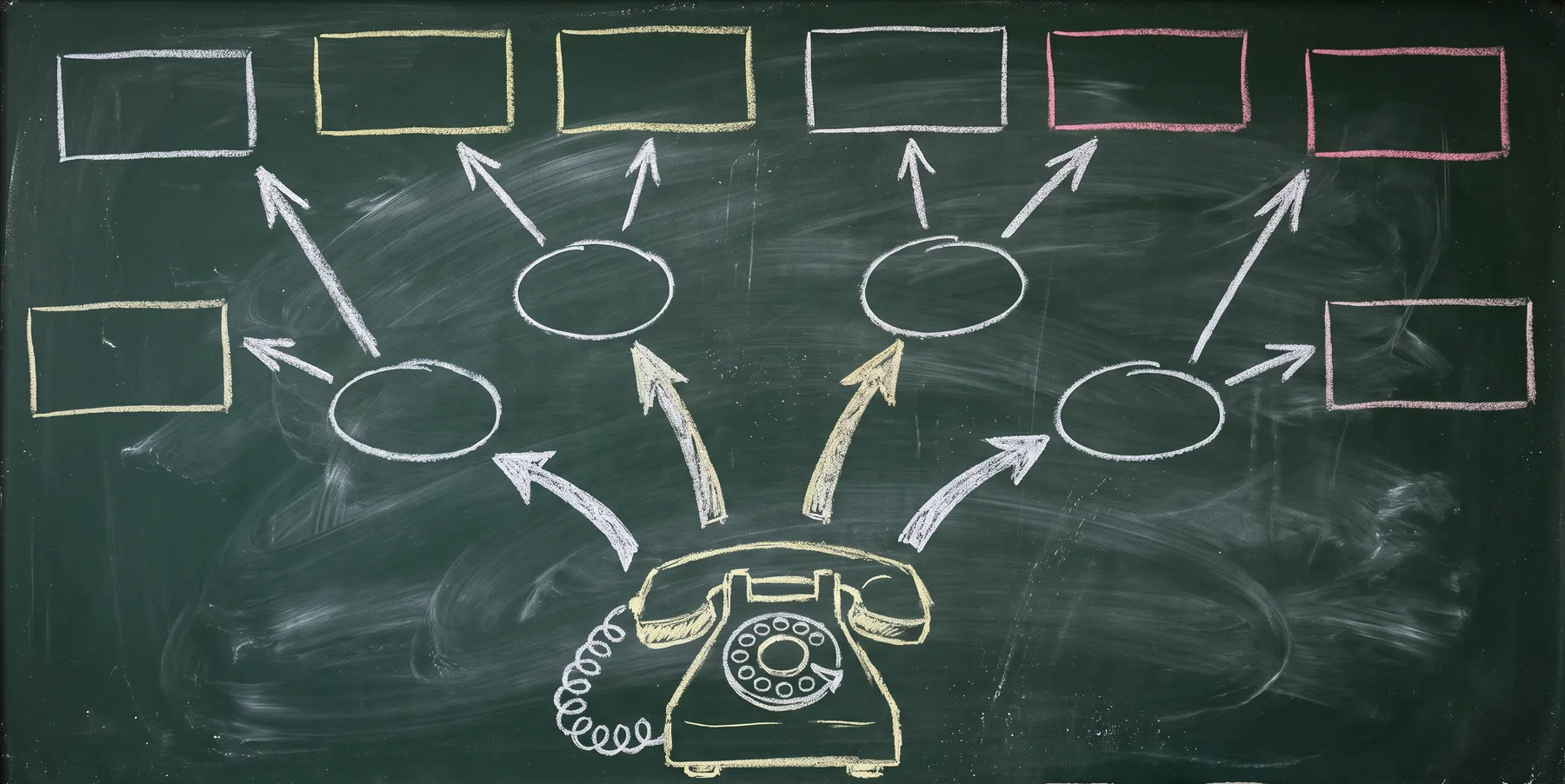
Call routing, taught in six lectures: the phone tree and its keypad, the queue and its skills, then routing by listening to what the caller actually says. Worked example on the board: Eve, Feniex’s assistant, who answers when the team can’t, and hands matters to the team in writing. No transfers, by design.
Course AH 25 · Taught by Deyaf, built from Eve
Syllabus
Every business phone line makes the same decision thousands of times: where should this call go? For decades the answer came from buttons. This course follows routing from the keypad to the queue to the sentence, and asks what changes when an Agentic Harness does the routing: when the thing that decides where a call goes can also listen, look something up, and write down what the caller needed.
| Session | Topic | On the board |
|---|---|---|
| Lecture 1 | Why we were asked to press 1 | The phone tree, and what it throws away |
| Lecture 2 | Queues, skills and the waiting room | Distributors, skill tags, the two kinds of transfer |
| Lecture 3 | Routing by listening | Intent, the definition, and four steps |
| Lab | Route this call | One caller, drawn two ways, with a counter |
| Lecture 4 | Eve’s case: routing in | Overflow, the greeting, five languages |
| Lecture 5 | Routing out: a hand-off, not a transfer | One ticket per matter |
| Lecture 6 | By language, by hours, by topic | The rules board, and a problem set |
| Office hours | Questions from the back row | Then homework, and the reading list |
Why we were asked to press 1
Before any machine could understand a sentence, a business that wanted to sort its calls had one reliable signal to work with: the buttons on the caller’s phone. Each key on a touch-tone keypad sends its own pair of tones down the line, and equipment at the other end can tell which key was pressed without understanding a single word. That is the whole trick behind the phone tree, known in the trade as interactive voice response, or IVR. A recorded voice reads a list of choices, the caller answers with a digit, and the system follows a branch.
The phone tree solved a real problem. A switchboard operator could route calls by asking where the caller wanted to go, but operators were expensive and could take only one call at a time. A menu could pick up every call at once, day or night, and point each one toward the right desk. For a business with a sales team, a support team and a returns desk, “press 1 for sales” was a genuine improvement over one ringing line and a harried receptionist.
The trouble is structural, and it is worth writing on the board. A tree only knows what it was built to ask. Its designer has to guess, in advance, every reason anybody will ever call, then fold those reasons into a handful of branches short enough for a caller to hold in their head while a voice recites them. Everything the caller knows about their own problem, which is usually a great deal, is thrown away except for a single digit. And every level of the tree costs the caller twice: once to listen to the options, and again to decide which of them their problem most nearly resembles.
Callers learned to fight back. They pressed zero, said “agent” over and over, or chose any branch at all in the hope of reaching a person sooner. Designers answered with longer menus, the familiar “please listen carefully, as our options have changed”, and more levels. The tree kept growing because the business kept discovering new reasons people call, and a tree can only learn by growing. Hold on to that sentence; Lecture 3 is its answer.
Queues, skills and the waiting room
The menu is only half of routing. The other half happens after the last press, in a piece of equipment the industry calls an automatic call distributor. Its job is to hold calls in a queue and hand each one to the next suitable person as they come free. Once contact centres had a queue, they could measure it: how many callers were waiting, for how long, and how many gave up before anyone answered.
Skills-based routing refined the queue. Instead of treating every agent as interchangeable, the distributor tags each person with skills: speaks Spanish, knows the warranty policy, handles large orders. A call that arrives carrying the right tags goes to someone with the matching skills, even if someone else has been free for longer. It is a sensible idea, and variations of it remain common in large contact centres.
Notice where the tags come from, though. The distributor cannot hear the caller. It knows the caller wants Spanish because they pressed 2, and it knows the matter is a warranty question because they pressed 4 and then 1. Skills-based routing is only as good as the guesses the caller made in the tree. If the person with a broken unit chose “technical support” because the unit is technical, they now sit in the wrong queue, and the fix is a transfer: whoever answers passes the call along, and the caller waits again.
In industry practice, transfers come in two kinds. A cold, or blind, transfer simply moves the call, and the next person starts from nothing. A warm transfer has the first person introduce the caller and summarise the problem before stepping away. Warm is kinder, but both share one weakness: the matter lives in the conversation, not on paper. If the line drops, if the next person is busy, or if the summary was rushed, the caller starts over. Repeating yourself is a familiar complaint in service: Zendesk’s CX Trends 2026 report found that 74% of consumers are frustrated when they have to repeat information (vendor-reported).
And then there is the overflow rule, the quiet last line of every routing plan: when no one is free, or the office is closed, where does the call go? For most businesses the honest answer has been voicemail, a recording that promises a call back and leaves the caller wondering whether anyone will ever listen to it.
Routing by listening
Speech recognition gave the tree a new input. Instead of “press 2”, menus began to say “say ‘billing’ or ‘orders’”, which is still a menu, only spoken aloud. The bigger change came when systems could take an open question, “how can I help?”, and work out what the caller wanted from whatever they said. The industry calls this intent-based routing, or a conversational IVR. The caller speaks naturally, software sorts the request into an intent, and the call goes where the intent points.
That is a real improvement, and it is also where many projects stop. Classifying intent only replaces the keypad. The call still lands in the same queue, with the same wait and the same transfer at the end. Worse, a system that listens well but has nothing reliable behind it can sound confident while knowing nothing. The best-known chatbot failures of recent years were not routing failures; they were systems that answered when they should have looked something up, or handed over. In Moffatt v. Air Canada, decided in February 2024, a tribunal held the airline responsible for what its website chatbot told a grieving customer about bereavement fares, advice that contradicted the airline’s own policy page.
Here is what changes when the listener is part of an Agentic Harness rather than a classifier bolted onto a menu. Anthropic’s engineering guide to building agents names routing as one of the basic patterns: classify the input, then send it to a specialised next step. A harness does that too, but its next step is not only a queue. It can be the answer itself, drawn from the business’s own records, or a written hand-off to the people who can act. The listening and the answering belong to one system, working under one set of rules.
“An Agentic Harness is everything around the AI model: what the assistant knows, what it remembers, where it meets customers, what it may do, and how your team teaches it.”
Deyaf’s definition. Read the long version: how an Agentic Harness works.
On the board, the difference fits in four verbs: listen, look it up, check the rules, reply. Deyaf puts it as the model is one step of four. Listening tells the harness what the caller means and which language they speak. The lookup finds the record that actually settles the question. The rules decide whether the assistant may answer, and what it must hand to a person instead. Only then is anything said. Routing stops being a question of which desk to ring, and becomes a question of where the answer lives.
Route this call
Illustrative example Build a synthetic caller: pick a language, an hour and what they say. The board draws the call twice: through an old-style phone tree, with a running count of presses and seconds, and through harness routing as Eve’s line works.
The old way: a phone tree
Presses 3Listening & waiting (model) 2:59
- Welcome message and recording notice+8 s
- “For English, press 1. For Spanish, press 2.” The caller presses 1.+11 s · 1 press
- Main menu: sales, orders, technical support, returns and warranty, repeat. The caller presses 3.+20 s · 1 press
- Support menu: installation, will it fit, software. The caller presses 2.+14 s · 1 press
- Every line is busy: hold music.+2 min (assumed)
- A person on the support desk answers, and the caller explains the question from the beginning.+6 s ringing
Harness routing: Eve’s line
Presses 0Menus noneHold none
- The team’s phones ring first.
- Every line is busy, so Eve answers instead of voicemail.
- “Hello, this is Eve, Feniex’s intelligence. How can I help you?”
- Listen: “Will this fit my vehicle?” She replies in English.
- Look it up: she checks the vehicle fitment record before saying anything about compatibility. If the check takes a moment, she says so rather than going quiet.
- Answer: if the record covers that vehicle, she answers from it, with one useful next step, then stops. If it doesn’t, she says she couldn’t confirm it and takes details for the team.
Old tree: 3 presses and 2:59 of listening and waiting before a person hears the question. Harness routing: no presses, no menu; Eve answers from the record.
Show the model’s assumptions
- The phone tree is a made-up but typical design, not Feniex’s or anyone else’s. Its language menu offers English and Spanish only.
- Timing model: a welcome of 8 s; each menu takes 5 s to introduce plus 3 s per option; a free person picks up after about 6 s of ringing; when closed, a 6 s notice plays before voicemail.
- Hold time is whatever you set on the slider. Real holds range from none to far longer; this is a model, not a measurement.
- The harness column shows no seconds on purpose: how long Eve takes depends on the question. Feniex’s measured figures are in Lecture 4, with their date and source.
- Callers’ words are shown in English; a Spanish, French or Portuguese caller would say them in their own language.
Routing in: the team rings first
Now the worked example. Eve is Feniex’s assistant, and at Feniex she answers the phone. Look carefully at where she sits in the routing plan, because it is the opposite of the usual pitch for AI on the phone. The team’s phones ring first. When a person is free, a person answers, and Eve never hears the call. Only when no one is free, or when the office is closed, does the call route to her, and she answers instead of voicemail.
In routing terms, Eve is the overflow rule. The slot that used to belong to a recording saying “please leave a message” now belongs to an assistant that can actually help. She greets every caller the same way:
“Hello, this is Eve, Feniex’s intelligence. How can I help you?”
That sentence does two jobs. It tells the caller they have reached an AI before anything else happens; disclosure at first contact is where regulation is heading, and since 2 August 2026 the EU AI Act’s Article 50 has required it of AI systems that interact with people in the EU. And it asks an open question, so there is no menu to learn. After the greeting, routing happens by listening. Callers who speak Spanish, French or Portuguese are answered in that language, in that language’s own voice; with English and Arabic, Eve works in five languages. Whatever the language, she searches one English library, so a caller in Portuguese gets the same facts as a caller in English. One assistant, every way in.
Her manner is part of the routing, too. She answers first, gives one useful next step, and stops. When she needs a detail, she asks for one at a time. Before any claim about a product, its compatibility, a warranty, a price or software, she checks the exact record. She never reads a web address aloud on a call. And she is never silent while she works. Voice engineers budget conversation in milliseconds; WebRTC.ventures’ latency guide notes that a voice agent starts to feel slow past about 800 ms, with under 500 ms preferred. A lookup can take longer than that, so the line fills the gap honestly: about a second and a half in, a short “One moment”; “Let me check on that” when a lookup starts; “Still checking” about every four seconds if it runs long.
A few rails come with the line. Every call is transcribed. A call lasts at most ten minutes. If Eve herself is down, a recorded fallback plays, so the line fails to a message rather than to silence. None of this is a separate phone product bolted onto a chatbot. Eve runs on the Agentic Harness Deyaf packages: her knowledge, memory, doors, rules and learning loop. The phone is one more door into the same system. More on her: Eve on the phone.
Her first week on the line · from the report card
- 102calls answered in her first week on the line, since Sep 17, 2026
- 86while the team was busy
- 16after the office closed
- 93%of callers stayed and talked
- 60calls handed straight to the team instead of left on hold (details taken; never a transfer)
- ~3 sto a finished reply on the phone (first word 1.6 s, finished 3.0 s)
- 86% / 10%handled well / material errors, 100 fixed test questions graded Sep 23, 2026
As of September 24, 2026 · Feniex’s internal Eve 3.0 report · machine-judged and provisional. The 86% is always shown with its 10% material-error rate. See Eve’s report card (weak spots included).
Routing out: a hand-off, not a transfer
Every routing plan needs an exit. Sooner or later a caller wants something the assistant cannot give: a return approved, a quote committed, a decision only a person should make. Eve claims no authority to approve returns, change accounts, place orders or decide sensitive matters. So what happens next is the second half of routing, and it is where her design is most deliberate.
The industry default is the live transfer. Contact-centre systems have always had it, and many voice-agent platforms now offer it as a built-in step: the caller is told they are being put through, and the person taking the call may get a short summary first. That is a reasonable design for a contact centre with people waiting on the other end. Eve does not work that way. No transfers, by design. When a matter needs a person, she takes the caller’s name and number and hands the matter to the team. Deyaf’s shorthand for the boundary is answering is not acting.
Why give up the transfer on purpose? Remember when Eve is on the line: when no one is free, or when the office is closed. A transfer at that moment would send the caller straight back to the people who could not answer, and into the hold music she exists to replace. Four reasons follow, and they are worth copying down.
- No dead-air holds. The caller is not parked in a queue for someone who may be busy for an hour. The call ends with a clear next step, and the caller gets their time back.
- The matter is written down. A transfer carries the problem in someone’s memory and a rushed summary. A hand-off carries it on the record: name, number and the matter, with the call transcript behind it. Nobody has to ask the caller to explain it all again.
- One ticket per matter. An unanswered question becomes a durable item, and when contact details are available, a support ticket is filed. One matter, one ticket, one place for the team to pick it up, instead of partial notes scattered across every desk the call passed through. An uncertain submission is not blindly retried, because a blind retry is how one matter turns into two tickets.
- She only says what is true. Eve tells the caller the matter is “with the support team” only once the ticket is confirmed as accepted. Until then she says what the result proves. Saving is not delivery, and delivery is not resolution.
The point matters because one of the public’s biggest fears about AI in service is being trapped. In a Gartner survey of 5,728 customers, published in July 2024, 64% said they would prefer companies did not use AI for customer service, and the top worry was that it would make reaching a person harder. Qualtrics, surveying more than 20,000 consumers in 2025, found half feared AI would block them from reaching a human. A hand-off that reliably lands with a person answers that fear. One that only sounds like it would confirm it. HumanLayer’s 12-Factor Agents makes the same point from the engineering side: contacting a human should be an explicit, structured step the software takes, like any other tool call. And it is normal, not a failure: in a December 2025 study of agents in production, 68% of the deployed agents ran at most ten steps before a person stepped in. For what she does when she doesn’t know, see what happens when she doesn’t know.
Illustrative example An after-hours caller whose unit stopped working wants to send it back. Step through the hand-off, and compare what an old-style transfer would be doing at the same moment.
1 · The caller explains
Eve listens and answers what her library can: she can explain the return policy she looked up. Approving the return is not hers to do.
A transfer, same moment: the caller explains to the menu, then to the first person.
2 · It needs a person
She says so plainly and offers to pass it to the team. No pretending, no “let me see what I can do”.
A transfer: “please hold”, and the call is sent toward the returns queue.
3 · Details, one at a time
Name first, then number, then the matter read back in the caller’s own terms. One missing detail at a time; corrections accepted.
A transfer: hold music. The returns desk is closed tonight.
4 · A durable item exists
The unanswered matter is recorded, with the call transcript behind it. It no longer depends on anyone’s memory.
A transfer: no one answers, so it drops to voicemail. The matter now lives in a recording.
5 · One ticket is filed
With contact details in hand, a ticket is submitted. She says only what the result proves: submitted, not yet accepted.
A transfer: tomorrow, someone plays the voicemail and calls back; the caller explains again.
6 · Accepted, so now she says it
The ticket system confirms it accepted the ticket. Only now does Eve tell the caller the matter is “with the support team”. One matter, one ticket.
A transfer: notes from each stop may or may not have been written down.
The ledger for this matter
- Tickets
- 0
- Matter
- in the conversation
- Contact
- not yet
- Status
- listening
- Eve may say
- an answer from the policy, and that a person is needed for the return

By language, by hours, by topic
Put the pieces together and you have the routing rules of a harness phone line. They fit on one board, and they are far shorter than a phone tree, because most of the tree’s branches have become lookups.
By hours
The first rule is about people, not the assistant. During open hours the team’s phones ring first. The assistant takes the overflow, the calls nobody is free for, and after the office closes it takes the calls that would otherwise have gone to voicemail. A business designing its own line should write down its hours and its ring order before it writes a word about AI; the assistant’s job is defined by the gaps in the team’s day, not the other way round.
By language
The old tree routed language with a key press and a queue of bilingual staff; if your language was not on the menu, you pressed 1 and struggled. A harness routes language by listening. Eve answers Spanish, French and Portuguese callers in that language’s own voice, searches one English library, and replies in the caller’s language: English inside, the customer’s language outside. Languages still deserve testing one at a time. The BabelArena benchmark, published this month, found that agents working in languages other than English used up to twice the tokens, made more tool errors, and slipped into English in structured output.
By topic
This is where the tree’s branches used to be. A harness does not route topics to desks first; it routes them to evidence. If the answer lives in the library, in a manual, a fitment record or a written policy, the assistant answers from it. If the question needs authority it does not have, or the record does not settle it, it takes the details and hands off. A failed lookup means “I couldn’t check”, not “it doesn’t exist”; unknown stays unknown. And every hand-off is a lesson waiting to happen: the answers the team gives can be reviewed and taught back, so the next caller with the same question gets it answered. That is the loop that makes her better, and it is supervised: only approved lessons are published.
By what is remembered
One ticket per matter depends on memory that is kept on purpose. The conversation record is one archive across web, email, text and phone, readable by the team and not searchable by visitors. Customer notes are short and historical, and never stand in for current facts. That separation is why a hand-off can carry the matter without carrying guesses: four kinds of memory, each with one job.
Problem set 6 · four routing decisions
Choose an answer; the board marks it and explains. Each scenario is an illustrative example.
-
Answer: to the team’s phones.
Routing by hours. The team’s phones ring first. The assistant is the overflow for when no one is free, and the after-hours answer instead of voicemail.
-
Answer: in Portuguese, from the same library.
Routing by language. Listening detects the language; the one library is searched in English and the answer comes back in Portuguese. An installation question lives in the manual, so it can be answered, not queued.
-
Answer: take the details and hand it off as one ticket.
Routing by topic. Approving returns needs authority the assistant does not have, and the returns desk is closed, so putting the caller through would only reach an empty desk. And in any case: no transfers, by design. The matter is written down and handed off.
-
Answer: only what the result proves.
One ticket per matter. “With the support team” is said only once the ticket is confirmed accepted. An uncertain submission is not blindly retried, because that is how one matter becomes two tickets.
Score: 0 of 4 answered
Questions from the back row
-
Is a phone tree ever the right tool?
Yes. For a few fixed, frequent choices where the caller already knows exactly what they want, a short menu is fast and predictable. The trouble starts when a tree tries to anticipate every reason anyone calls, and grows a level at a time.
-
Can Eve put me through to a person?
No. No transfers, by design. If a person were free, the team’s phones would have answered before Eve did. She takes your name and number and hands the matter to the team, and says it is “with the support team” only once the ticket is confirmed accepted.
-
Does Eve answer every call to Feniex?
No. She is Feniex’s overflow and after-hours line. The team’s phones ring first; she answers when no one is free or the office is closed, instead of voicemail. Every call is transcribed, calls last at most ten minutes, and a recorded fallback plays if she is down.
-
Isn’t intent-based routing just a smarter menu?
On its own, it is. Classifying the caller’s words and dropping them in the same queue replaces the keypad and little else. The harness difference is what sits behind the listening: the records to answer from, the rules about what may be said, and a hand-off that writes the matter down. See what the assistant can and cannot do.
-
Where do the week-one numbers come from?
From Feniex’s internal Eve 3.0 report, as of September 24, 2026: machine-judged and provisional, not an independent benchmark. The 86% handled-well figure always comes with its 10% material-error rate, and the report keeps its weakest category in the test on purpose.
-
Could my business have a line like this?
Eve is the worked example. Deyaf’s early-access builder lets you set up and preview an assistant from your own knowledge. Choosing a phone channel there records your intent; it does not activate a number. Doors are switched on one at a time: switch on each door deliberately, or start from a front desk that knows.
Draw your own routing board
Before anyone builds anything, put your line on one board. It takes about as long as this lecture did.
- Your hours, and the order your team’s phones ring in. That is where an assistant’s shift begins.
- The languages your callers actually speak.
- The five questions callers ask most, and the record that answers each one.
- The matters only a person may decide, and who on the team should receive the hand-off.
Then start with one good job, and try it in the builder: about ten minutes for a preview and a saved setup, no account needed.
Build your assistant